A time signature is a symbol written at the beginning of a piece of music, immediately after the clef sign.
It tells us:
- How many beats are in each measure (bar).
- Which note value receives one beat.
Parts of a Time Signature
Top Number
The top number tells us how many beats are in one measure.
Example:
- 2 = 2 beats per measure
- 3 = 3 beats per measure
- 4 = 4 beats per measure
- 6 = 6 beats per measure
Bottom Number
The bottom number tells us which note gets one beat.
| Bottom Number | Note Value |
|---|---|
| 1 | Whole Note |
| 2 | Half Note |
| 4 | Quarter Note |
| 8 | Eighth Note |
| 16 | Sixteenth Note |
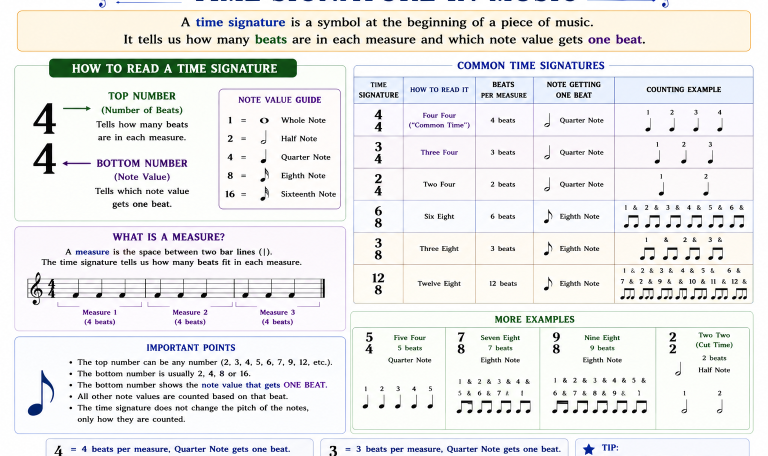 Common Time Signatures
4/4 Time (Common Time)
- 4 beats in each measure.
- Quarter note gets 1 beat.
3/4 Time
- 3 beats in each measure.
- Quarter note gets 1 beat.
2/4 Time
- 2 beats in each measure.
- Quarter note gets 1 beat.
6/8 Time
- 6 eighth-note beats per measure.
- Usually felt as 2 groups of 3.
What is a Measure (Bar)?
A measure is the space between two bar lines.
Example in 4/4:
| ♩ ♩ ♩ ♩ | ♩ ♩ ♩ ♩ |
Summary
A time signature is the musical “traffic sign” that organizes rhythm.
- The top number tells how many beats are in a measure.
- The bottom number tells which note value gets one beat.
- It helps musicians count correctly and play together in time.
Remember:
Top Number = Number of Beats
Bottom Number = Note that Receives the Beat.