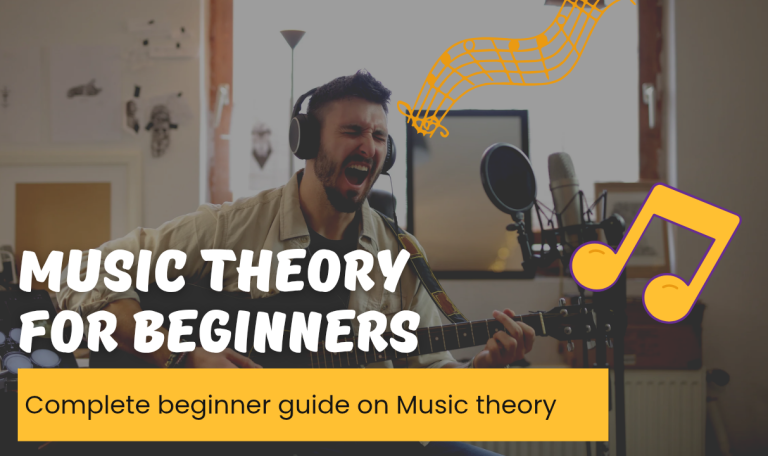
Music Theory for Beginers

Uncategorized
Wishlist Share

About Course

This course is designed for absolute beginners who want to understand the language of music. Whether you are learning piano, violin, saxophone, voice, or any other instrument, this course will give you the foundation needed to read, understand, and perform music with confidence.

By the end of this course, students will be able to read basic music notation, understand rhythm, identify scales and intervals, recognize key signatures, and apply music theory concepts in practical musical situations.

What Will You Learn?

  • Music Theory for Beginners is a comprehensive introductory course designed to equip students with the fundamental knowledge and skills needed to read, understand, and perform music confidently. Whether you are learning piano, guitar, violin, voice, or any other musical instrument, this course provides the essential theoretical foundation required for musical growth and success.
  • Students will learn the language of music, including staff notation, note reading, rhythm, time signatures, scales, key signatures, intervals, chords, and musical expressions. Through practical examples, exercises, and quizzes, learners will develop the ability to read sheet music, understand musical structures, and apply theoretical concepts to performance.
  • This course is suitable for children, teenagers, adults, beginners, hobbyists, and aspiring musicians who want to build a strong foundation in music theory.

Course Content

Module 1- Music Theory For Beginers
Music Theory for Beginners is a foundational course designed to introduce students to the essential principles of music theory in a simple, practical, and engaging way. Whether you are learning piano, violin, saxophone, voice, or any other instrument, this course will help you understand the language of music and improve your confidence as a musician. Throughout the course, students will learn how to read music notation, understand rhythm and time signatures, build major scales, identify key signatures, recognize intervals and chords, and interpret common musical symbols and expressions. Lessons are presented in a step-by-step format with practical exercises, quizzes, and assignments to reinforce learning. By the end of the course, students will possess the theoretical knowledge needed to read and understand sheet music, communicate effectively with other musicians, and support their musical growth regardless of their chosen instrument.

Module 2- The Staff
Introducing the foundation of how music is written and read using standard notation. Students learn how musical sounds are represented on the staff, which consists of five lines and four spaces. Each line and space corresponds to a specific musical note, forming the basis for reading sheet music

Module 3 – Rhythmn and Time
Introduces students to the rhythmic structure of music, focusing on how time is measured and organized in musical pieces. It helps learners understand how long each note lasts and how silence is also an important part of music.

Module 4- Scales, and Keysignatures
In this module, students will learn how key signatures work, how scales are formed, and how musicians use scales to create melodies and harmonies. By the end of this module, students should be able to identify common key signatures, construct major scales, and understand the relationship between scales and keys.

Module 5: Interval And Chords
In this module, students will learn about intervals and chords, which are the building blocks of melody and harmony. Students will understand how notes relate to one another, how chords are constructed, and how chords function in music. By the end of this module, students should be able to identify common intervals, build major and minor chords, and recognize basic chord progressions.

Module 6: Musical Expressions
Music is more than playing the correct notes and rhythms. Musical expressions help performers communicate emotions, mood, and character in music. These markings tell musicians how loudly, softly, quickly, smoothly, or forcefully to play. By the end of this module, students will be able to identify common musical expressions, dynamic markings, tempo markings, and articulation symbols used in musical notation.

Student Ratings & Reviews

No Review Yet
No Review Yet